

HVAC School vs Apprenticeship: Which Option Gets You to Work Faster?
Most people comparing HVAC school vs apprenticeship are asking one simple question: How can I start working as soon as possible? It is a fair question. If you are ready for a career change or considering trade school after high school, you probably want to begin earning a paycheck without wasting time.
The answer, though, is not as simple as many people expect.
An HVAC apprenticeship may get you onto a job site sooner because you are learning while you work, because HVAC school takes time before you begin your first job. But getting to work faster is only one part of the decision. You also have to think about how prepared you will feel on your first service call, how quickly you can build confidence in the field, and even how your training affects your path toward becoming a licensed HVAC contractor in Ohio.
That is why so many students compare these two options before enrolling. One path starts with real job-site experience. The other starts with structured training, hands-on lab work, and instructors who can help you build skills before you are responsible for a customer’s heating or cooling system.
By the end of this article, you will have a better understanding of how each path works, where each one has advantages, and why many HVAC professionals see school and an apprenticeship as two steps in the same career rather than two completely different choices.
What Does “Getting to Work Faster” Really Mean?
Getting to work faster may mean different things to different people.
Getting Your First Paycheck
Most students comparing HVAC school vs apprenticeship are focused on one thing: getting hired. In that case, an apprenticeship has a clear advantage. If you find a contractor that is willing to hire you and train you right away, you can make money while you learn the trade.
This might be an attractive option for someone who already has a friend in the industry or an employer willing to invest in training. Instead of spending your days in a classroom, you are on job sites, riding with experienced technicians, carrying tools, and seeing how HVAC systems are installed and repaired.
But getting your first paycheck is only one milestone. It is not the only way to measure how quickly you are moving toward a successful HVAC career.
Feeling Ready for Your First Service Call
Imagine two new technicians arriving at their first job.
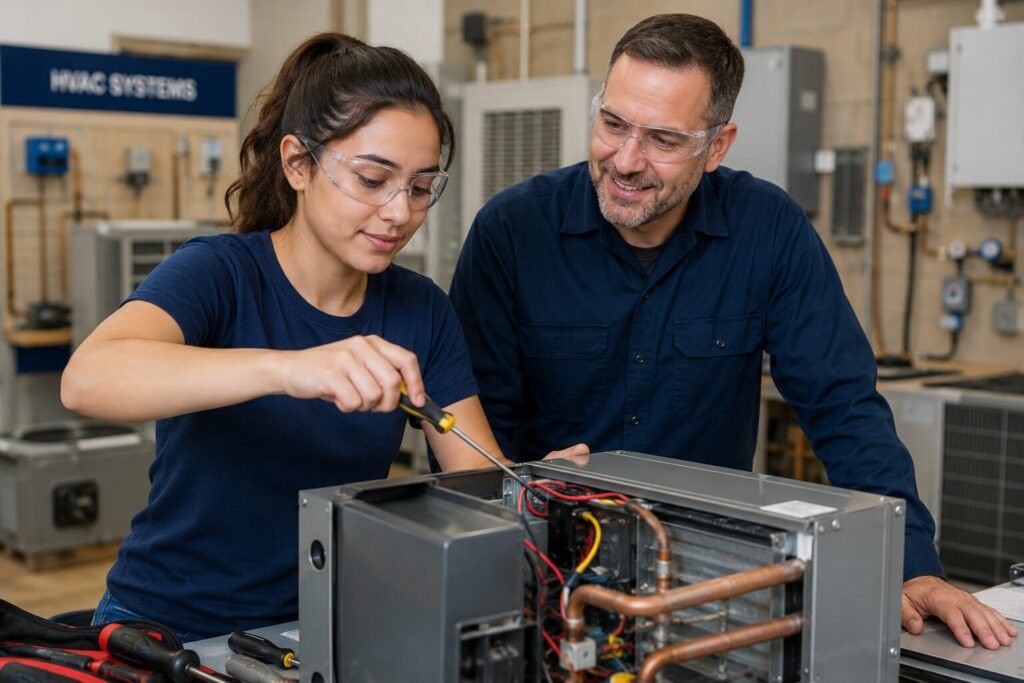
One has spent months watching experienced technicians work and helping where needed. The other has already practiced recovering refrigerant, reading wiring diagrams, checking airflow, using gauges, and troubleshooting electrical problems in a training lab.
Both are beginning their careers. The difference is how much hands-on practice they have already completed before a customer is depending on them.
That is one reason many students choose HVAC school first. They build confidence in a controlled learning environment where mistakes become lessons instead of expensive service calls.
Thinking Beyond Your First Job
Many prospective students focus on getting hired. Experienced HVAC technicians often think about something else entirely: where they want to be five or ten years from now.
Maybe you want to become a lead technician. Maybe you want to specialize in commercial HVAC. Or you hope to own your own HVAC business one day.
Those goals are more than just landing your first job. They require knowledge building, technical skill development, and experience gaining that will enable you to keep moving forward throughout your career.
How an HVAC Apprenticeship Works
“I’d rather get paid than sit in a classroom.” It is one of the most common reasons students consider an HVAC apprenticeship. Instead of spending your days in a training lab, you begin working for an HVAC company and learn alongside experienced HVAC technicians while earning a paycheck.
For many people, that is an appealing way to start a career. You are seeing real equipment, visiting customers’ homes and businesses, and getting a firsthand look at what the job is really like.
That said, most apprentices are not troubleshooting furnaces or diagnosing air conditioning problems on their first day. Like any new employee, they begin with the basics and gradually take on more responsibility as their skills grow.
What Your First Year Might Look Like
Many new apprentices are surprised by how much they spend watching before they start doing.
One morning might begin by loading equipment into the service truck. The next stop could involve handing tools to an HVAC technician while they replace a blower motor or trace an electrical problem. You might begin to check temperatures, take pressures or do routine maintenance under supervision with experience.
Every day brings something different. One week could be filled with air conditioner tune-ups during the summer. The next might involve helping install a new furnace or heat pump.
It is hands-on learning from the beginning, but your responsibilities usually grow a little at a time.
Why Every Apprenticeship Is Different
One thing many prospective students do not realize is that no two apprenticeships look exactly alike.
Your experience depends on the company that hires you and the type of work they do. A residential HVAC contractor may specialize in furnaces, air conditioners and heat pumps in homes. A commercial contractor may do more work with rooftop units, larger equipment and office buildings.
The HVAC technician you work with also shapes your experience. Some enjoy explaining every step of a repair. Others expect you to learn mostly by watching and asking questions.
That variety is one reason apprenticeships can be so valuable. It is also why many students choose to build a foundation in HVAC school first. When you already understand the basics of refrigeration, electrical systems, airflow, and safety, you can spend less time trying to understand why something works and more time learning how to solve problems in the field.
What You Learn in HVAC School Before You Start Working
Starting your first HVAC job is a lot less intimidating when you already understand how heating and cooling systems work.
HVAC school gives you the time to first build that foundation while you’re trying to learn the basics on top of a busy workday. You learn how electricity moves through a system, why refrigerant changes pressure and temperature, how airflow affects comfort, and what happens when one part of the system fails. That knowledge makes it easier to understand what you are seeing once you begin working in the field.
Many students say this is where everything starts to click. The diagrams in a textbook become real equipment sitting in front of you. The terms you have heard—compressor, contactor, evaporator coil, capacitor—become parts you can identify, test, and understand.
Making Mistakes in the Lab Instead of on the Job
Nobody expects you to know everything when you are learning a trade. The difference is where those early mistakes happen.
Imagine you are checking electrical voltage and accidentally connect your meter incorrectly. Or maybe you misread a wiring diagram and spend twenty minutes looking for a problem that is somewhere else.
In a training lab, those moments become part of the lesson. An instructor can explain what happened, help you troubleshoot the problem and let you try again until the process makes sense.
But when you’re on a customer service call, the pressure’s different. Someone is waiting for their furnace to work again. A business may have employees working in an uncomfortable building. There is less time to stop and ask questions.
That is one reason many students appreciate learning in a lab before stepping onto a job site. They build confidence through repetition before they are expected to solve problems in the field.
Why Confidence Matters on Day One
There is a difference between watching someone repair an HVAC system and understanding why they are doing each step.
Students who complete hands-on HVAC training have often connected gauges, recovered refrigerant, brazed copper tubing, diagnosed electrical circuits, and worked with furnaces, air conditioners, and heat pumps multiple times before interviewing for their first job.
That does not mean they know everything. Every HVAC technician continues learning throughout their career.
It does mean they arrive with a level of confidence that can make those first weeks on the job feel less overwhelming. Instead of seeing unfamiliar equipment for the first time, they are building on skills they have already practiced.
For employers, that foundation can be valuable. They can focus on teaching company procedures, customer service, and real-world troubleshooting rather than introducing every tool and every HVAC concept from the beginning.
Why Many Students Choose HVAC School First
By now, you have probably noticed that this is not really a choice between two competing paths. It is a decision about how you want to begin your HVAC career.
An apprenticeship gives you the chance to earn a paycheck while learning from experienced technicians. The HVAC school gives you the opportunity to get familiar with the equipment, develop your skills and build your confidence before you begin working with customers.
That foundation really makes it much easier for many students to transition into the workforce. Instead of learning every concept for the first time on the job, they arrive with hands-on experience already behind them.
Then You Continue Learning on the Job
Graduating from HVAC school does not mean your training is finished.
New equipment comes out, technology changes, and every service call is a new challenge. Working alongside experienced HVAC technicians helps you build on what you learned in school while gaining the practical experience employers value.
That is why many graduates continue into entry-level HVAC positions where they receive employer training or participate in apprenticeship programs. Rather than choosing between school and an apprenticeship, many HVAC technicians experience both during their careers.
Taking the Next Step with OBC
If you are starting with little or no HVAC experience, building your skills before entering the field can make a real difference.
The HVAC Applications program at OBC combines classroom instruction with hands-on training so you can practice diagnosing problems, working with HVAC equipment, and using industry tools before your first day on the job.
After graduation, OBC can also help students connect with employers and apprenticeship opportunities as they begin their careers. Instead of choosing one path or the other, many graduates use school as the first step before continuing to learn in the field.
One additional benefit that many prospective students overlook is Ohio’s licensing requirements. While an apprenticeship generally requires four years of qualifying work experience before meeting the experience requirement for an Ohio HVAC contractor license, graduates of an approved HVAC diploma program receive one year of experience credit toward that requirement. That means many graduates can qualify with three years of field experience while continuing to meet the state’s other licensing requirements.
If your goal is simply to earn a paycheck as quickly as possible and you already have an employer ready to train you, an apprenticeship may be the right fit. But if you want to begin your career with a stronger technical foundation, develop confidence before working in customers’ homes, and shorten the experience requirement toward becoming a licensed HVAC contractor in Ohio, HVAC school offers advantages that continue long after graduation.
For many students, the decision is not HVAC school or an apprenticeship. It is HVAC school first, then an apprenticeship. That combination allows you to enter the workforce with hands-on training, continue learning from experienced HVAC technicians, and keep moving toward your long-term career goals.
Frequently Asked Questions About Trade School vs Apprenticeship
Is HVAC school better than an apprenticeship?
It depends on how you want to start your career. With an apprenticeship, you learn on the job and get paid, while HVAC school gives you hands-on training and technical knowledge before you start working. Many technicians complete HVAC school first and then continue learning through employer training or an apprenticeship.
Can you get an HVAC job without going to trade school?
Yes. Some employers hire entry-level workers and train them on the job. However, completing HVAC school can help you to develop technical skills, get hands-on experience and feel more prepared when applying for your first position.
How long does HVAC school take?
Program length varies by school. OBC’s HVAC Applications diploma program can be completed in 9 months attending full-time.
Should I go to HVAC school before an apprenticeship?
Many students choose that path. Learning HVAC fundamentals in school before working in the field can make it easier to understand what you’re seeing on the job and build confidence during your first months with an employer.
Want to Learn More?
Contact us to learn more about our HVAC Applications program today or apply online.